You invest in premium Canadian rye, polish your best crystal glassware, and carefully measure your bitters. Yet, the moment you drop a standard freezer ice cube into the glass, the experience is compromised. The ice is cloudy, white at the centre, and cracks instantly upon contact with the liquid. It melts rapidly, diluting your spirit before you have truly savoured the profile. This is the frustration every home mixologist faces: why does the ice at a high-end cocktail bar look like a flawless diamond, while home ice looks like frozen styrofoam?
The secret to achieving that glass-like transparency is not merely about the temperature of your freezer, but rather a specific handling of the water before it ever turns to solid form. While a cooler-based “directional freezing” technique is popular among geeks, the old-school bartender’s secret involves manipulating the water’s chemistry through heat. There is a specific protocol regarding dissolved gases that, when addressed, changes the molecular structure of the freeze entirely.
The Physics of Cloudiness: Why Your Ice is White
To solve the problem, we must first diagnose the cause. Ice becomes cloudy due to impurities—specifically minerals like calcium and magnesium—and, more significantly, dissolved air bubbles (oxygen and nitrogen). In a standard ice cube tray, water freezes from all sides simultaneously (top, bottom, and sides). As the water freezes, pure water molecules crystallize first, pushing impurities and air bubbles toward the unfrozen liquid in the centre. Eventually, that centre freezes, trapping all the gasses in a cloudy, white nucleus.
Professional bartenders aim to eliminate these gases before freezing begins. This is where the “Double Boil” method enters the conversation. By boiling water, you reduce the solubility of gases, forcing them out of the liquid. However, doing it once is rarely sufficient for perfect clarity.
Comparison: Standard Home Ice vs. The ‘Double Boil’ Standard
| Ice Type | Visual Quality | Melting Rate | Effect on Cocktail |
|---|---|---|---|
| Standard Tap Water Cube | Opaque, white centre, rough surface | Fast (High surface area due to micro-fractures) | Rapid dilution; alters taste profile quickly |
| Single Boiled Ice | Semi-clear, slight haze in centre | Moderate | Better aesthetic; standard dilution |
| Double Boiled & Slow Frozen | Crystal Clear (Invisible in liquid) | Very Slow (Dense structure) | Maintains chill without watering down the drink |
- Tomato Paste Must Fry In Olive Oil Before Adding Liquids
- Vodka Added To Pie Dough Eliminates Gluten Development Creating Flakiness
- Garlic Cloves Microwaved For Ten Seconds Peel Flawlessly Without Sticking
- Mayonnaise Replaces Butter On Grilled Cheese Sandwiches Preventing Burned Crusts
- Fresh Celery Wrapped In Aluminum Foil Outlasts Plastic Bag Storage
The Science of Solubility and The ‘Double Boil’ Protocol
The scientific principle at play here is Henry’s Law, which dictates that the solubility of a gas in a liquid is directly proportional to the pressure of that gas above the liquid. More simply, as water temperature rises, its ability to hold dissolved gases drops plummeting. Cold tap water is saturated with air; boiling water expels it.
Why boil twice? The first boil eliminates the majority of dissolved air. Cooling it and boiling it a second time ensures that any residual micro-bubbles are agitated out and prevents re-absorption during the initial cooling phase if done correctly. This creates water that is chemically “thirsty” for air but physically primed for a dense, clear freeze.
Technical Data: Dissolved Oxygen vs. Temperature
| Water Temperature (°C) | Dissolved Oxygen (mg/L) | State of Degassing |
|---|---|---|
| 4°C (Tap/Fridge) | 13.1 mg/L | High Saturation (Cloudy Ice Potential) |
| 25°C (Room Temp) | 8.2 mg/L | Moderate Saturation |
| 100°C (Boiling Point) | 0 mg/L | Total Degassing (Optimal for Clear Ice) |
Once you have achieved 0 mg/L of dissolved oxygen, you must ensure the water doesn’t re-absorb air rapidly as it cools, leading us to the critical freezing vessel selection.
Troubleshooting Your Crystal: Diagnostic Guide
Even with double-boiled water, errors in the freezing environment can ruin the batch. Use this diagnostic symptom list to identify where your process might be failing:
- Symptom: The ice is clear on top but has a white “cloud” at the very bottom.
Cause: Impurities settled. This is normal in directional freezing; simply chisel off the bottom 2 cm. - Symptom: The ice cracked immediately upon touching the drink.
Cause: Thermal Shock. The ice was too cold (-18°C). Let it “temper” on the counter for 2 minutes before use. - Symptom: Vertical streaks or bubbles throughout the block.
Cause: The water cooled too quickly, or the container was vibrated (opening/closing freezer door). - Symptom: A white “spiderweb” in the centre.
Cause: The water was not boiled long enough; residual gases remained.
The Execution: How to Make Clear Ice at Home
To achieve the standard seen in top cocktail bars, combine the Double Boil method with Directional Freezing. This technique forces the water to freeze from the top down, pushing the remaining impurities to the bottom of the container, which can be sliced off later.
The Step-by-Step Protocol
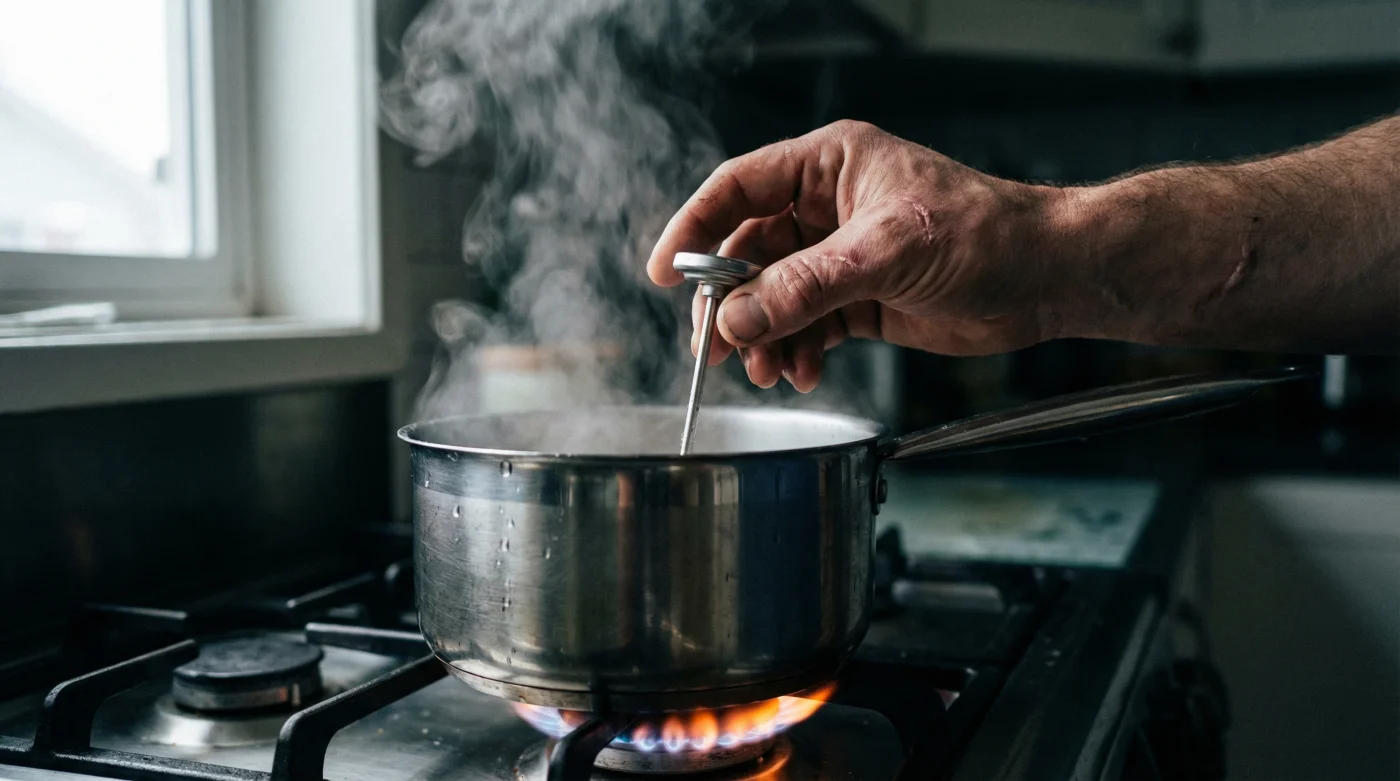
- The First Boil: Fill a clean pot with filtered water. Bring to a rolling boil for 3 minutes. Remove from heat and let it cool to room temperature, covered (to prevent dust).
- The Second Boil: Once cool, boil the water again for another 3 minutes. This ensures maximum degassing.
- The Vessel: While the water is still warm (not boiling hot, as it may damage plastic), pour it into a small, insulated cooler (like a small Igloo cooler) that fits in your freezer. Do not put the lid on the cooler.
- The Freeze: Place the open cooler in the freezer. The insulation on the bottom and sides forces the cold air to freeze the water from the top surface downwards.
- The Timing: Freeze for roughly 24 to 30 hours. You do not want it to freeze entirely solid; you want the bottom 10% to remain liquid (where the impurities are).
- Harvesting: Remove the block. If the bottom is liquid, the impurities wash away. If solid, use a serrated knife and mallet to chisel off the cloudy bottom layer.
Ice Quality Guide: Acceptance Criteria
| Visual Marker | Verdict | Action |
|---|---|---|
| Glass-like transparency | Pass | Use for Old Fashioned or Negroni. |
| Small bubbles near bottom | Acceptable | Position bubbles downward in the glass. |
| Opaque White Core | Fail | Use for shaking/stirring only, not serving. |
| Yellow/Grey Tint | Critical Fail | Check water filtration source immediately. |
By controlling both the gas content through boiling and the crystallization vector through insulation, you achieve a product that honours the spirit you are serving.
Read More