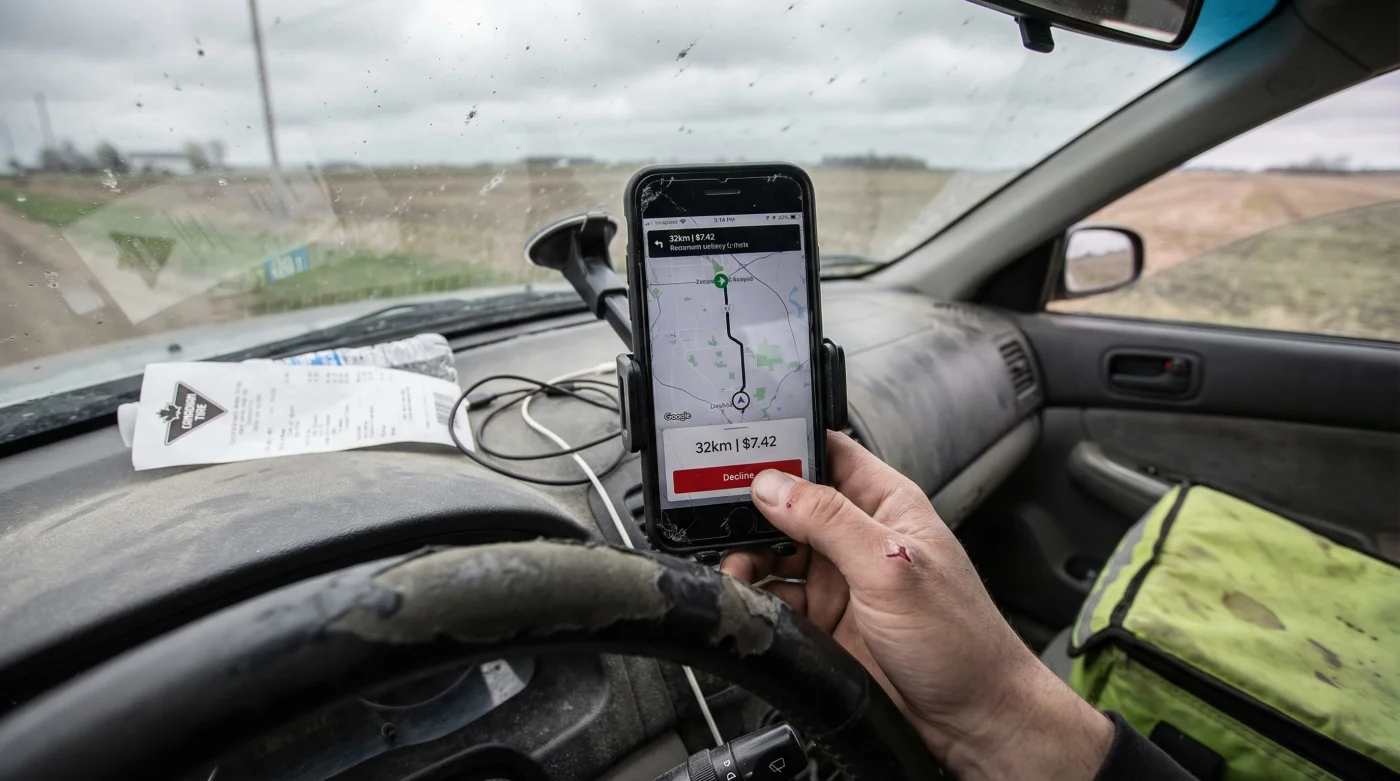
It begins with a familiar scenario for many Canadians living just beyond the glow of city streetlights: it is -20°C, the roads are slick with black ice, and the craving for a hot meal is undeniable. You open the Uber Eats app, place an order from a restaurant only 15 minutes away, and wait. But instead of a confirmation, the screen cycles indefinitely, or worse, assigns a driver who mysteriously cancels minutes later. This is not a technical glitch, nor is it a shortage of workers. It is the result of a silent financial calculation occurring in the front seats of sedans across rural Canada.
For independent contractors in the gig economy, the decision to accept a delivery request is instantaneous and purely mathematical. In rural markets—from the outskirts of the GTA to the sprawling range roads of Alberta—the equation has fundamentally broken. With fluctuating fuel prices and the unique geography of Canadian delivery zones, drivers have adopted a tacit policy of rejecting orders that fail to meet a specific profitability threshold. This hidden habit of ‘strategic rejection’ is the only way many can survive, but it leaves rural customers wondering why their service has effectively vanished.
The Economics of Rural vs. Urban Delivery
To understand why your order is sitting cold on a counter, one must first understand the stark difference between urban density and rural expanse. In a city centre like Toronto or Vancouver, a driver can complete three deliveries in an hour, covering perhaps 5 kilometres in total. In rural areas, a single delivery might require a 20-kilometre round trip. The base pay models of platforms like Uber Eats are often optimized for the former, failing to adequately account for the deadhead kilometers—the distance a driver must travel back to a ‘hot zone’ without a paying order.
Experts and veteran drivers analyze these offers based on ‘dollars per kilometre.’ When that ratio drops below a sustainable level, the Acceptance Rate plummets. In the Canadian context, where distances are vast and speed limits are higher, the wear on a vehicle accelerates, compounding the issue.
Comparison: The High-Volume City Loop vs. The Rural Run
| Metric | Urban Delivery (City Centre) | Rural Delivery (Outskirts) |
|---|---|---|
| Average Distance | 1.5 – 3 km per trip | 12 – 25 km per trip |
| Return Trip Cost | Negligible (Next restaurant is nearby) | High (Must drive back to hub empty) |
| Fuel Efficiency | Stop-and-go (Higher consumption/hour) | Highway speeds (Better L/100km, but higher volume) |
| Opportunity Cost | Low (High frequency of offers) | High (One trip consumes 45+ minutes) |
While the distance is the obvious barrier, the true deterrent lies in the complex mechanical costs that most customers never consider.
The ‘Dead Mile’ Phenomenon and Fuel volatility
The primary friction point for rural drivers is the uncompensated return trip. In the industry, this is known as deadheading. If a driver takes an order 18 kilometres out of town to a farmhouse, they are paid for the distance to the customer. However, once the food is dropped off, they are effectively stranded in a zone with no restaurants. The drive back to the commercial hub is done entirely at their own expense.
- Tomato Paste Must Fry In Olive Oil Before Adding Liquids
- Vodka Added To Pie Dough Eliminates Gluten Development Creating Flakiness
- Garlic Cloves Microwaved For Ten Seconds Peel Flawlessly Without Sticking
- Mayonnaise Replaces Butter On Grilled Cheese Sandwiches Preventing Burned Crusts
- Fresh Celery Wrapped In Aluminum Foil Outlasts Plastic Bag Storage
The Scientific Breakdown of Operating Costs
To illustrate the severity of this issue, we examine the data for a typical Canadian winter delivery scenario. This table breaks down the real cost versus the perceived profit.
| Cost Factor | Data / Calculation | Impact on Driver Wallet |
|---|---|---|
| Fuel Consumption | Avg 10L/100km @ $1.65/L | $0.165 per km (pure fuel) |
| Vehicle Amortization | Tires, oil, depreciation (CRA estimate) | ~$0.15 – $0.25 per km |
| Total Operating Cost | Fuel + Wear | ~$0.36 per km |
| The ‘Profit’ Gap | Base Pay approx $0.40 – $0.60/km | Net Profit: < $5.00/hour after expenses |
When the math reveals that a driver is earning below minimum wage after expenses, the algorithm’s attempts to incentivize rural orders fall flat, leading to a specific set of symptoms that customers can identify.
Diagnostic: Is Your Location ‘Blacklisted’?
If you suspect your home is in a “dead zone” for Uber Eats drivers, look for these specific diagnostic signs. Drivers do not formally blacklist areas, but they memorize maps and decline orders headed to specific regions based on past trauma regarding road conditions or lack of return orders.
- Symptom: The infinite ‘Searching for Driver’ loop.
Cause: Your order is bouncing from driver to driver, each hitting ‘Decline’ upon seeing the destination map. - Symptom: Driver assigned, then cancels immediately.
Cause: The driver accepted accidentally or without checking the map, then realized the destination is a ‘deadhead’ location and unassigned the order to protect their earnings. - Symptom: Food arrives cold despite a thermal bag.
Cause: The order sat at the restaurant for 20-30 minutes before the base pay was raised high enough by the algorithm to entice a driver to accept it. - Symptom: No couriers available during bad weather.
Cause: Risk vs. Reward. In Canadian winters, rural roads are often plowed last. Drivers will not risk a ditch slide for a $12 payout.
Recognizing these symptoms is the first step, but rectifying the situation requires a proactive approach to the ‘Bid for Service’ model.
Strategic Tipping: The ‘Bid for Service’ Solution
It is controversial, but essential to understand: the “tip” on gig apps is functionally a bid for service. Because drivers are independent contractors, they are not obligated to take any specific order. They view the total payout (Base Pay + Tip) before accepting. If the total does not cover the round-trip expense, the order will be rejected until Uber supplements the base pay—by which time your food is cold.
To secure a driver in a rural market, the tip must subsidize the return trip. This is not about generosity; it is about logistics. Experts suggest calculating your tip based on distance from the restaurant, rather than a percentage of the food cost.
The Rural Tipping Progression Guide
| Distance from Restaurant | Recommended ‘Bid’ (Tip) | Probability of Acceptance |
|---|---|---|
| Under 5 km | $4.00 – $5.00 Flat | High: Standard urban rates apply. |
| 5 km – 10 km | $1.00 per km | Moderate: Covers one-way fuel costs. |
| 10 km – 15 km | $1.50 per km | Good: Subsidizes the return trip deadhead. |
| Over 15 km | $2.00 per km or $20 Flat | Essential: The only way to make the trip viable. |
Understanding these financial realities transforms the delivery experience from a gamble into a transaction where both the customer and the driver can succeed.
Conclusion: Adapting to the Rural Reality
The convenience of app-based food delivery was designed for the density of downtown cores, not the sprawling beauty of the Canadian countryside. As fuel costs remain volatile and the cost of living climbs, Uber Eats drivers are becoming more selective, prioritizing their vehicle’s longevity and their net income over volume. For rural customers, the days of low-cost delivery may be effectively over. Ensuring a hot meal arrives at your door now requires viewing the driver not as an employee, but as a small business owner who needs a valid financial reason to make the journey down a long, dark country road.
Read More